
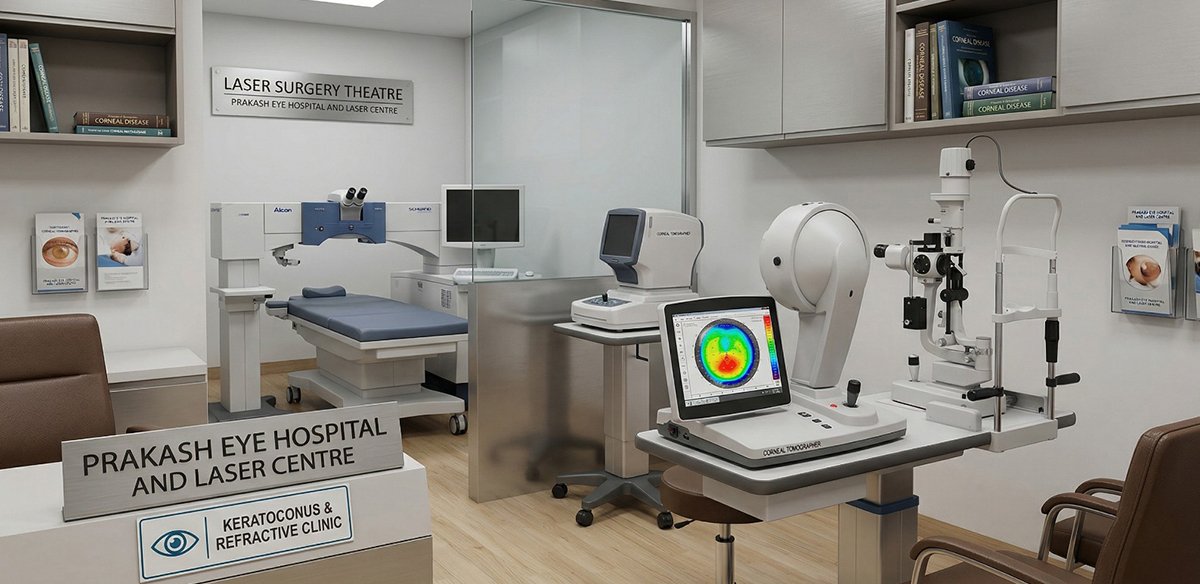
Advanced Keratoconus Diagnosis and Treatment at Prakash Eye Hospital, Mansarovar, Jaipur
Keratoconus is a progressive eye condition in which the normally round cornea becomes thin and starts to bulge forward into a cone-like shape. This irregular, cone-shaped cornea affects the way light enters the eye and can lead to blurred vision, glare, halos, and increasing dependence on glasses or contact lenses. If not diagnosed and treated at the right time, Keratoconus can gradually worsen and affect daily activities such as reading, driving, studying, and screen use.
At Prakash Eye Hospital, Mansarovar, Jaipur, we offer a dedicated Keratoconus Clinic focused on early detection, precise diagnosis, and advanced treatment planning for patients of all age groups. Under the expert care of Dr. Piyush Gupta, our goal is to detect the disease early, stop its progression, improve visual quality, and help patients preserve their vision for the long term. For patients searching for Keratoconus treatment in Jaipur, Corneal Cross-linking (CXL) Jaipur, Scleral lenses Jaipur, or the best Keratoconus specialist in Mansarovar, Prakash Eye Hospital is committed to delivering trusted and advanced corneal care.
What Is Keratoconus?
Keratoconus is a disorder of the cornea, the clear front surface of the eye. In this condition, the cornea becomes weaker and thinner over time, causing it to protrude outward into a cone shape. This change in corneal shape leads to irregular astigmatism and distorted vision that may not be fully corrected with regular glasses.
Keratoconus often begins in the teenage years or early adulthood, but it can also be diagnosed later. Since it is usually progressive, early diagnosis is extremely important. Timely treatment can slow or stop further damage and reduce the risk of severe visual loss.
At Prakash Eye Hospital, our Keratoconus Clinic is designed to provide complete evaluation and customized treatment for every stage of the disease.
Why Early Diagnosis of Keratoconus Is Important
Early diagnosis can make a major difference in the long-term outcome of Keratoconus. In the initial stages, the condition may appear as frequent spectacle number changes or increasing astigmatism. Many patients ignore these warning signs until vision becomes significantly disturbed.
Early detection helps because it allows us to:
- Identify Keratoconus before major corneal damage occurs
- Monitor disease progression accurately
- Recommend Corneal Collagen Cross-Linking (C3R/CXL) at the right stage
- Improve visual outcomes with specialized lenses
- Prevent the need for more invasive surgery in advanced cases
If you or your child has repeated changes in glasses number, blurred vision, or increasing astigmatism, a detailed corneal evaluation is strongly recommended.
Keratoconus Symptoms and Warning Signs
Common Symptoms of Keratoconus
Keratoconus symptoms may develop gradually. Many patients first notice that their glasses no longer provide clear vision, even after repeated changes in prescription.
Common signs include:
- Blurred or distorted vision
- Frequent changes in spectacle number
- Increasing cylindrical power or astigmatism
- Sensitivity to light
- Glare and halos around lights
- Difficulty seeing clearly at night
- Eye strain or headaches due to poor vision
- Double vision in one eye
- Sudden worsening of vision in advanced cases
If these symptoms are present, especially in teenagers or young adults, a proper Keratoconus diagnosis should not be delayed.
How Keratoconus Is Diagnosed
At Prakash Eye Hospital, Jaipur, we use advanced corneal imaging and detailed eye examination to diagnose Keratoconus accurately, even in early or subtle cases.
Diagnostic evaluation may include:
- Detailed eye consultation and vision assessment
- Refraction to check glasses power and irregular astigmatism
- Slit lamp examination of the cornea
- Corneal Topography
- Corneal Tomography
- Pachymetry to measure corneal thickness
- Assessment of corneal curvature and structural changes
Advanced Corneal Topography and Tomography
These tests are essential for detecting the shape, steepness, and thinning pattern of the cornea.
They help identify:
- Early Keratoconus
- Progressive Keratoconus
- Cone location and severity
- Suitability for CXL, lenses, or surgery
- Need for long-term monitoring
This advanced approach allows us to create a personalized treatment plan for each patient.
Keratoconus Treatment Services at Prakash Eye Hospital
At our Keratoconus Clinic in Mansarovar, treatment is tailored according to the stage of the disease, age of the patient, corneal condition, and visual needs. Our focus is not only on controlling progression but also on improving quality of vision.
What is Corneal Cross-Linking?
Corneal Collagen Cross-Linking (C3R or CXL) is one of the most important treatments for Keratoconus. It is designed to strengthen the corneal tissue and stop the disease from progressing further.
During the procedure, riboflavin eye drops are applied to the cornea, followed by controlled ultraviolet light exposure. This process increases the strength of collagen fibers in the cornea and stabilizes its structure.
Benefits of CXL:
- Helps stop or slow progression of Keratoconus
- Preserves existing corneal shape
- Reduces the risk of worsening vision
- May prevent the need for corneal transplant in many cases
- Most effective when done at the right stage
For patients looking for Corneal Cross-linking (CXL) in Jaipur, Prakash Eye Hospital offers careful case selection, advanced evaluation, and expert management.
In many patients, glasses do not provide satisfactory vision because the cornea becomes irregular. In such cases, specialized contact lenses can significantly improve vision and day-to-day comfort.
We may recommend:
Rigid Gas Permeable lenses create a smooth optical surface over the cornea and help improve clarity in mild to moderate Keratoconus.
Rose-K lenses are specially designed for Keratoconus and can provide better fitting and improved vision for patients with irregular corneas.
Scleral lenses are larger diameter lenses that rest on the white part of the eye rather than directly on the cornea. They are known for:
- Excellent comfort
- Better stability
- Improved visual quality
- Suitability for advanced or irregular corneas
- Relief in patients with lens intolerance to smaller lenses
For patients searching for Scleral lenses Jaipur, our clinic provides detailed fitting guidance and lens-related support.
Intracorneal Ring Segments (ICRS), also called Intacs, are tiny ring-like implants placed within the cornea to help reshape its contour. These are used in selected Keratoconus patients to regularize the corneal surface and improve visi on quality.
Benefits of ICRS:
- Helps flatten the cone-shaped cornea
- Improves corneal shape
- May improve unaided and corrected vision
- Can enhance tolerance for glasses or contact lenses
- May delay the need for transplant in suitable cases
Not every patient is a candidate for ICRS surgery. A detailed corneal assessment is required to determine whether this option is appropriate.
When Keratoconus becomes very advanced or when corneal scarring develops, a corneal transplant may be required. This is usually considered when other treatments are no longer sufficient to provide useful vision.
Corneal transplant options may include:
DALK (Deep Anterior Lamellar Keratoplasty)
A partial-thickness corneal transplant in which the diseased front layers of the cornea are replaced while preserving the healthy inner layer.
PKP (Penetrating Keratoplasty)
A full-thickness corneal transplant used in advanced cases where deeper corneal layers are affected.
When transplant may be needed:
- Advanced corneal thinning
- Significant corneal scarring
- Poor vision not corrected by lenses
- Intolerance to contact lenses
- Severe irregularity affecting daily life
At Prakash Eye Hospital, we carefully evaluate advanced Keratoconus cases and guide patients toward the most appropriate surgical plan.
Who Should Get Evaluated for Keratoconus?
You should consider a corneal evaluation if:
- Your glasses number changes frequently
- You have increasing astigmatism
- Vision remains unclear even with updated glasses
- There is a family history of Keratoconus
- You rub your eyes frequently
- You are a teenager or young adult with rapidly changing vision
- You have been told you have an irregular cornea
Early evaluation is especially important for school and college students, because progression can be faster in younger patients.
Why Choose Prakash Eye Hospital for Keratoconus Treatment in Jaipur?
Choosing the right eye hospital is important when managing a progressive corneal disease like Keratoconus. At Prakash Eye Hospital, we combine clinical expertise, modern diagnostics, and personalized care for every patient.
Dr. Piyush Gupta is committed to offering patient-focused corneal care with careful diagnosis, clear guidance, and treatment planning based on the latest ophthalmic principles.
We use modern corneal evaluation tools such as Corneal Topography and Tomography for accurate diagnosis and follow-up.
From diagnosis to CXL, specialized lenses, surgical planning, and long-term monitoring, patients receive comprehensive care in one place.
Each Keratoconus case is different. We recommend treatment based on disease stage, corneal shape, age, lifestyle, and visual needs.
Our hospital is easily accessible for patients looking for a trusted eye hospital in Mansarovar and advanced Keratoconus treatment in Jaipur.
We believe that informed patients make better decisions. Our team explains the condition, treatment options, expected outcomes, and follow-up needs in simple language.
Book a Keratoconus Consultation in Jaipur
If you are experiencing blurred vision, frequent power changes, glare, or have been told you may have Keratoconus, do not delay your eye evaluation. Early diagnosis can protect your vision and open the door to effective treatment options.
At Prakash Eye Hospital, Mansarovar, Jaipur, our dedicated Keratoconus Clinic offers advanced diagnosis, Corneal Cross-linking (CXL), specialized contact lens solutions, and surgical care for advanced cases. Under the expert guidance of Dr. Piyush Gupta, we are committed to helping patients achieve better long-term visual outcomes with compassionate and modern eye care.
Frequently Asked Questions
Is Keratoconus curable?
Keratoconus is generally not considered fully curable, but it can be effectively managed. The main goal is to stop progression and improve vision. Treatments like Corneal Cross-Linking (CXL) can stabilize the cornea, while specialized lenses and surgeries can improve visual function.
Does Corneal Cross-Linking hurt?
CXL is usually performed under local anesthesia using eye drops, so the procedure itself is generally well tolerated. Some discomfort, irritation, watering, or light sensitivity may occur for a few days after treatment, but this is temporary and manageable with medication and follow-up care.
Can glasses correct Keratoconus?
In very early stages, glasses may help. However, as the cornea becomes more irregular, glasses often become less effective. In such cases, specialized contact lenses like RGP, Rose-K, and Scleral lenses may provide better vision.
Will I always need surgery for Keratoconus?
No. Many patients do not need surgery if Keratoconus is detected early and treated appropriately. CXL and specialized lenses can help many patients manage the condition effectively. Surgery is usually reserved for selected or advanced cases.
Is Keratoconus a progressive disease?
Yes, Keratoconus is often progressive, especially in younger individuals. That is why regular follow-up and early intervention are very important.
Schedule Your Consultation Today
Visit Prakash Eye Hospital to meet a trusted team for Keratoconus treatment in Jaipur and expert corneal care in Mansarovar.
Location: Prakash Eye Hospital Mansarovar, Jaipur, Rajasthan
Disclaimer: All medical procedures carry certain risks. Eligibility for any treatment is subject to a detailed clinical evaluation. Results may vary from patient to patient.